Oxy-fuel cutting: power and cost control for thick plate.
Thermal cutting technology for structural steel and large thicknesses
What is oxy-fuel cutting and how it is used in industry
Thermal separation by controlled oxidation
Oxy-fuel cutting is an industrial cutting technology used for carbon steel. It applies a jet of oxygen and fuel gas to heat the material to ignition temperature. Pure oxygen then reacts with the steel, generating a controlled oxidation that removes material and produces a continuous cut without mechanical force.
It is effective for carbon steel plates from 20 mm to over 200 mm. In this range, laser or plasma are often less cost-efficient. This makes oxy-fuel cutting common in heavy fabrication, shipbuilding, and structural steel manufacturing.
Types of oxy-fuel cutting and applications
Adapted to different production environments and automation levels
Manual oxy-fuel cutting
Used in maintenance and on-site operations. Requires experienced operators.
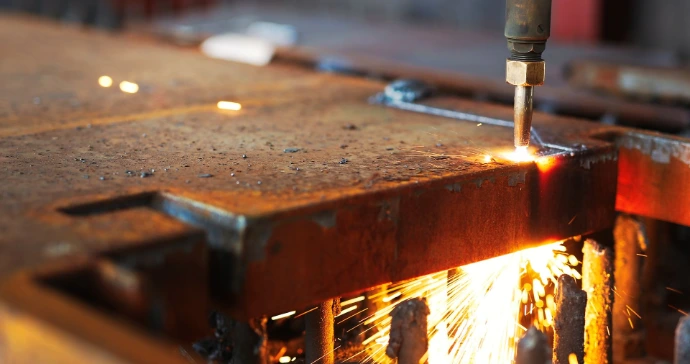
CNC oxy-fuel cutting
Automated, precise, and programmable. It integrates with CAD/CAM systems and allows for repetitive cuts with high quality.
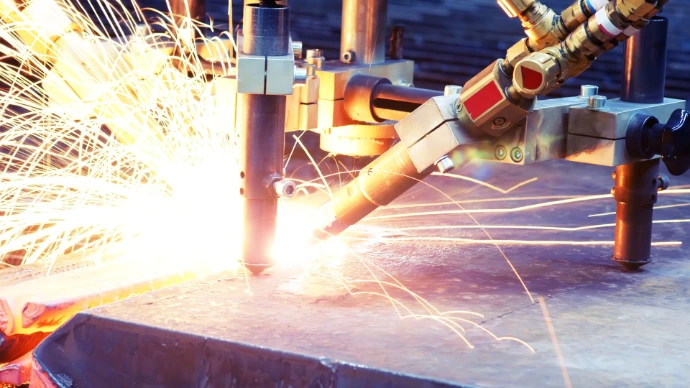
Multi-bevel oxy-fuel cutting
Creates bevels for welding preparation. Common in metal structures.
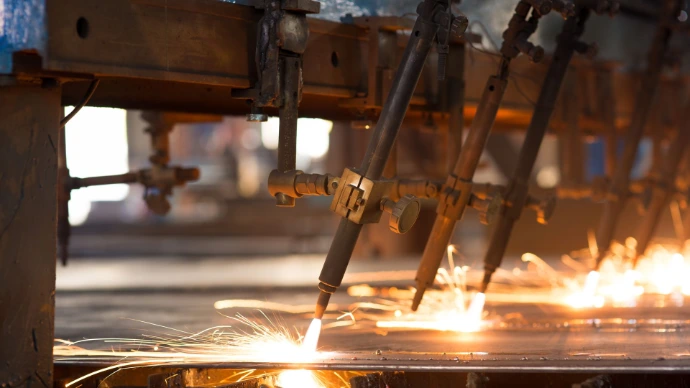
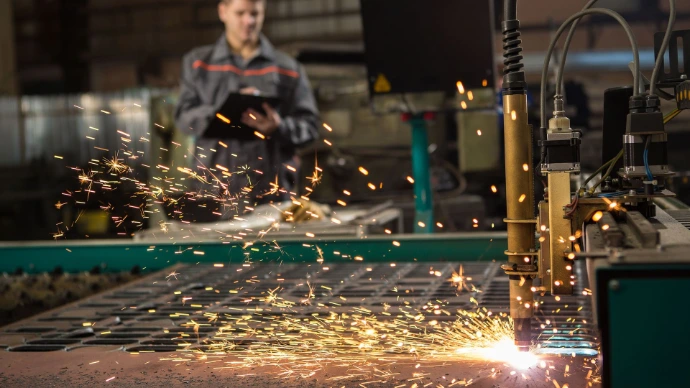
Combined oxy-fuel and plasma cutting
Both technologies can be used in the same machine to handle different thickness ranges.
Software guide for oxy-fuel cutting
The role of software in CNC oxy-fuel cutting
Specialized CAD/CAM software for oxy-fuel cutting allows for automating paths, managing piercings and preheats, optimizing material nesting, and reducing thermal distortion. The result is a more controlled, repeatable, and efficient process.
Furthermore, CNC oxy-fuel cutting software must integrate with ERP and MES systems to ensure traceability, eliminate information silos, and support the evolution of the production environment. This improves not only the cutting process but also the productivity and profitability of industrial oxy-fuel cutting. Here are several factors to consider when choosing the right software:
Thermal control
Prevent deformation before cutting starts
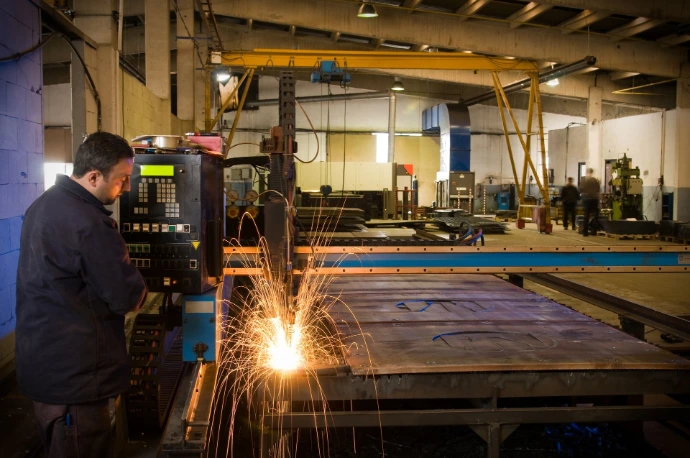
Accurate heat control is essential. The software must adjust parameters based on material and thickness, including:
- Preheating times
- Progressive piercing
- Delays between cuts
- Thermal pauses
This reduces deformation, cracking, and oxidation issues.
Multi-head and bevel management
Increase throughput and improve finishing
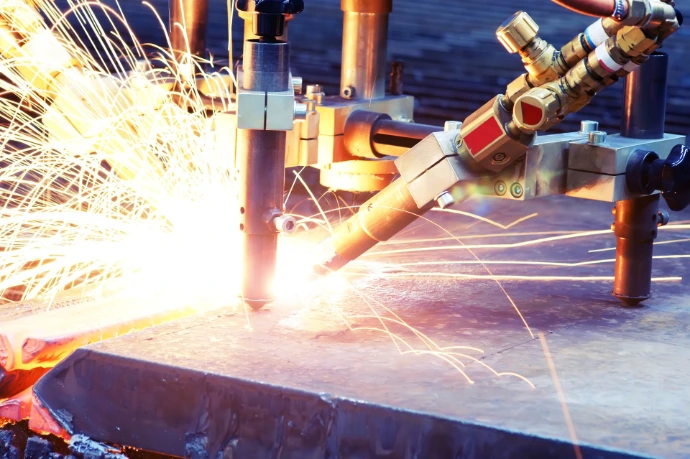
Industrial machines often use multiple torches. The software must:
- Coordinate multiple heads simultaneously
- Control individual height and speed adjustments
- Manage automatic beveling for welding preparation

Nesting for thick plates
Maximize material usage
Material cost is high in thick plates. The software should provide:
- Automatic and manual nesting
- Scrap reuse strategies
- Rules based on thickness and thermal behavior
System integration
Connect design, production, and traceability
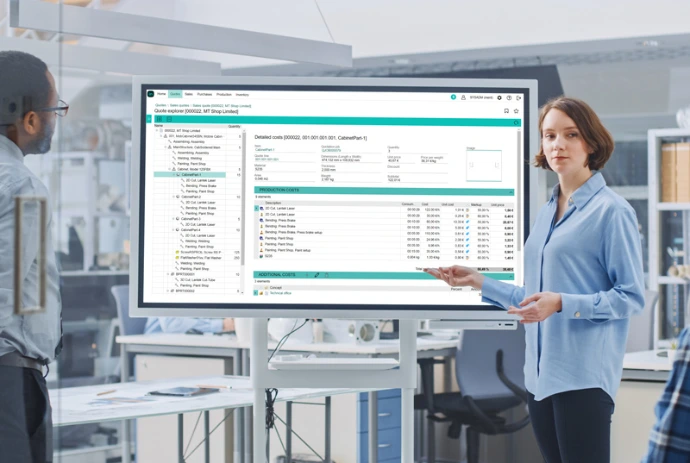
The software must integrate with CAD/CAM, ERP, and MES systems to connect design, planning, production, and management in the same workflow. This allows manufacturers to import design data, release jobs automatically, control sheet inventory, and track material consumption, cutting times, and production data from the shop floor. ERP MES
Connect all your production on the shop floor

Simulation and collision detection
Avoid errors before production
3D simulation allows validation of cutting paths and head movements. This reduces the risk of collisions, thermal stress zones, and structural defects.

Support for auxiliary processes
Maintain production continuity
The system should include operations such as:
- Marking
- Punching
- Drilling
- Sealing
Integrating these steps reduces machine changes and keeps production consistent.

Training and technical support
Ensure stable operation
Oxy-fuel cutting combines thermal control, gas management, and process planning. The software provider should offer:
- Training by role, including operators and programmers.
- Technical support with fast problem-solving capabilities, regular updates and access to specialized documentation.
Lantek solutions for oxy-fuel cutting
Two specialized modules for optimizing the sheet metal process.
CAD/CAM software for sheet metal oxy-fuel cutting
Thermal stability, productivity, and profitability in large thicknesses
Lantek Expert Cut is a CAD/CAM solution for CNC oxy-fuel cutting machines. It is designed for medium and thick carbon steel sheet metal, where thermal control, material usage, and cutting cost are key factors.
The system supports advanced cutting elements such as bevels, loops, and bridges, which can be assigned manually or automatically according to material type and thickness. It also manages different types of torches and nozzles, allowing changes during the process to maintain the right cutting conditions.
It includes key features such as:
Multi-torch and multi-blowpipe cutting, with automatic nesting.
Bevel cutting using rotating or triple heads for welding preparation.
Micro-cuts and bridges to anchor parts and reduce piercing times.
Continuous cutting between parts to reduce machining time and cost.
Industrial marking by powder, ink, punching, drilling, or sealing.
Linear cutting for rectangular and square parts.
The 3D simulation of the real oxy-fuel cutting sequence makes it possible to validate toolpaths, cutting heads and material evacuation before sending the job to the machine, preventing thermal deformation, collisions and costly errors.
It is designed for heavy boiler making, metal structures, and industrial manufacturing with large thicknesses, where oxy-fuel cutting remains one of the most cost-efficient technologies.
CAD/CAM for oxy-fuel cutting of tubes and structural profiles
Welding preparation and 3D control in complex structures
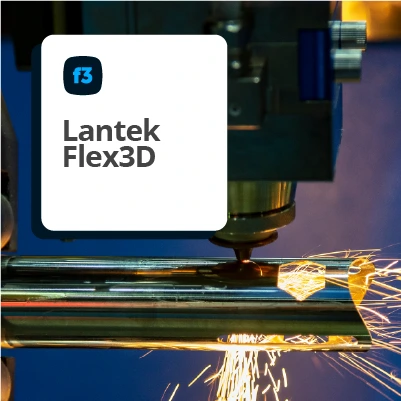
For three-dimensional applications, Lantek offers a 3D CAD/CAM environment for metal tubes, pipes, and structural profiles through specialized solutions within the same platform.
In tube and pipe cutting, Lantek Flex3d Tubes allows users to:
Create complete or partial bevels for welding preparation.
Generate holes of any shape at any point and angle.
Manage intersections between tubes with automatic calculation and visualization.
Project 2D geometry onto cylindrical surfaces.
Copy operations in linear, circular, or grid patterns.
Work with roller or spindle clamping systems.
In structural profile cutting, Lantek Flex3d Steelwork allows users to:
Manage different types of oxy-fuel cutting heads.
Perform orthogonal and beveled cuts with precision.
Program internal, side, and irregular operations on beams and profiles.
Simulate the real cutting sequence in 3D to avoid collisions and programming errors.
This environment is designed for metal construction, welded structures, industrial piping, and large structural assemblies that require precision, beveling, and repeatability under demanding thermal conditions.
Success stories from fabrication workshops using industrial oxy-fuel cutting machines
Frequently Asked Questions
These are some common questions about oxy-fuel cutting and our software.
Oxy-fuel cutting is suitable for medium and thick carbon steel. It is not suitable for aluminum, stainless steel, or non-ferrous materials.
Oxy-fuel cutting machines require lower initial investment and operating cost when working with thick steel, especially above 40 mm. Although slower than laser or plasma, they offer higher penetration and are well suited for heavy fabrication, structural parts, and industrial maintenance. Lower investment and operating cost for thick steel. Slower than laser or plasma, but better suited for heavy sections and structural applications.
Oxy-fuel cutting can be used from around 10 mm up to more than 300 mm. The most common and stable range is between 20 mm and 200 mm, depending on the machine setup and gas configuration. From around 10 mm to over 300 mm. The most common range is 20 mm to 200 mm.
Yes, a machine equipped with CNC control, oxy-fuel torches, gas regulation, and safety systems is required. It must also work with compatible CAD/CAM software to control toolpaths and thermal parameters.
A specialized CAD/CAM system is required to manage thermal behavior, nesting, multi-head cutting, bevels, and simulation. This ensures consistent quality and control in industrial oxy-fuel cutting.
Integration is achieved by connecting the cutting system with MES and ERP platforms.
This allows job planning, tracking of time and materials, and full production visibility.
Lantek MES WOS Live connects machines with central management.
Yes, if it supports multiple cutting technologies and their specific parameters.
Automatic nesting improves material usage, reduces scrap, and helps manage heat distribution across the plate. This leads to lower costs and more stable cutting conditions.
By optimizing cutting sequences and grouping operations.
CAM software controls these parameters and reduces idle time.
Lantek Expert automates this process to reduce consumption and cycle time.
Yes, modular software environments allow the addition of new machines, cutting technologies, and processes without replacing the system or duplicating workflows.
Thick carbon steel parts such as structural components, base plates, heavy machinery parts, and reinforcements are well suited for oxy-fuel cutting due to their thickness and cost requirements.
Key criteria include machine compatibility, thermal control, nesting capabilities, multi-head support, simulation tools, integration with ERP and MES, scalability, and availability of technical support.
Oxy-fuel cutting is recommended when working with thick carbon steel plates and when cost control is more important than cutting speed or tight tolerances. It is not suitable for non-ferrous materials.
A multi-axis CAD/CAM system is required to control cutting angles, synchronize heads, and simulate the full process. Integration with ERP and MES is also necessary for full traceability.