Metal profile sawing
Precision and productivity in tubes, beams, and structural bars
What is metal sawing?
Material separation without heat or burr formation
Metal sawing is one of the most widely used technologies for processing structural profiles, tubes, beams, and solid bars in industrial environments.
Unlike thermal cutting methods such as laser or plasma cutting, industrial saws use toothed tools that remove material progressively. This process avoids significant heat input and prevents thermal deformation, preserving the mechanical properties of the metal.
Saw cutting is particularly suitable for preparing structural components and is widely used in sectors such as:
Metal structure manufacturing
Industrial construction
Heavy machinery
Energy
Frame and chassis production
Unlike shearing, which are used to cut sheet metal, industrial saws are specifically designed to work with structural materials such as:
Metal profiles
Tubes
Beams
Solid bars
This makes sawing a key technology in profile processing lines and structural manufacturing centers.
Sawing machines can operate in manual, semi-automatic, or fully automatic modes, depending on the production volume and workshop requirements.
Types of industrial saws for metal
Industrial saws are used to cut metal profiles, tubes, beams, and solid bars in structural manufacturing. The choice of equipment depends on production volume, material type, and required accuracy.
Band saw for metal profiles
The band saw is one of the most common solutions for cutting metal profiles. It uses a continuous toothed blade that enables precise cuts in tubes, beams, and bars.
Main advantages:
Versatility across different profile types
Consistent cutting quality
Ability to cut thick materials
It is widely used in metal structure manufacturing and machinery production.
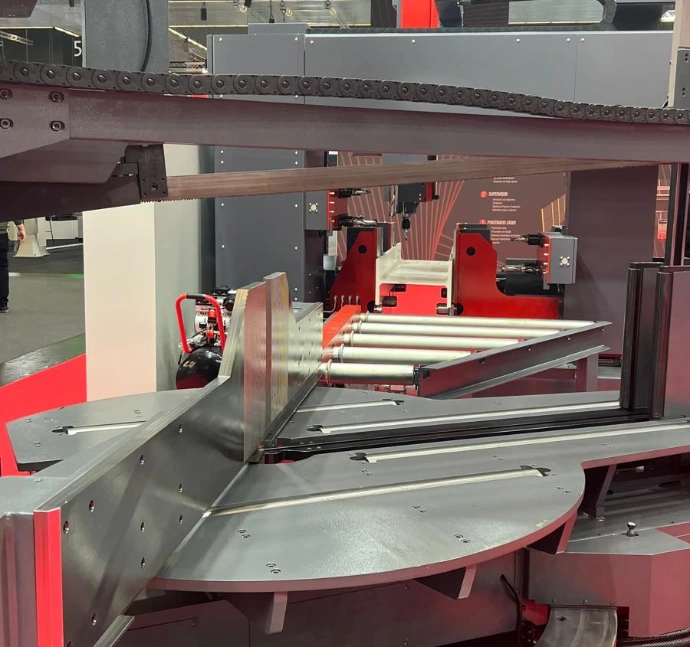
Circular saw for mass production
Circular saws use a toothed circular blade to perform fast and repetitive cuts.
They are typically used in high-volume production environments where speed and repeatability are required for profile cutting.
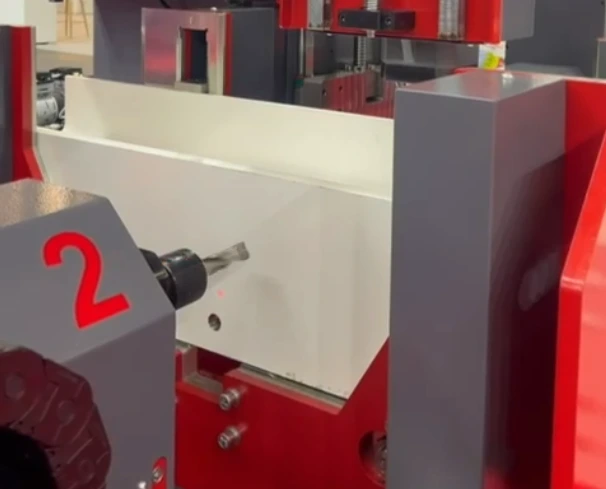
Processing centers with sawing and drilling
Profile processing centers combine multiple operations into a single machine, such as sawing and drilling.
This allows the complete machining of profiles without repositioning the part, improving accuracy and reducing handling time.
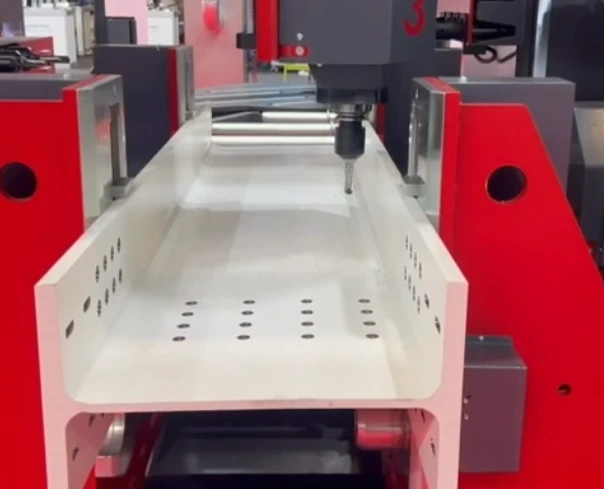
What should software for sawing include?
Sawing efficiency depends not only on the machine but also on process planning, profile management, and CNC programming.
Specialized software allows for optimizing job preparation, improving material utilization, and automating the generation of cutting programs.
Key capabilities to consider.
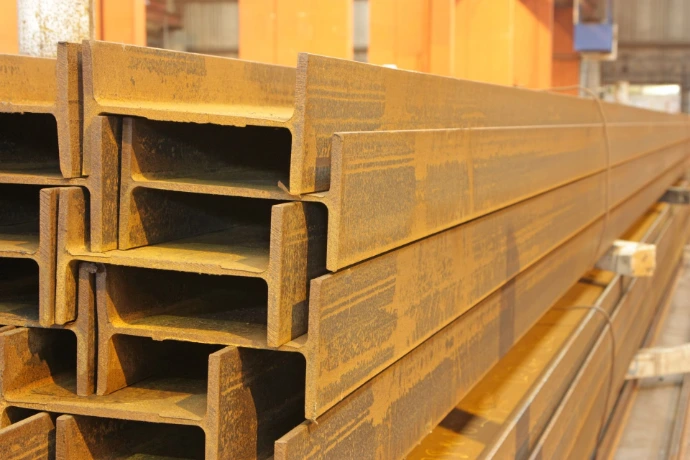
Optimize the use of profiles and bars
Maximize material usage and reduce waste
Effective software automatically calculates the most efficient cutting sequences to make full use of each profile or bar.
This enables:
Reduced material waste
Better production planning
Improved use of available stock
Cut optimization is especially relevant when working with long or high-cost structural materials.
Management of material lengths and remnants
Control profile inventory and reuse leftovers
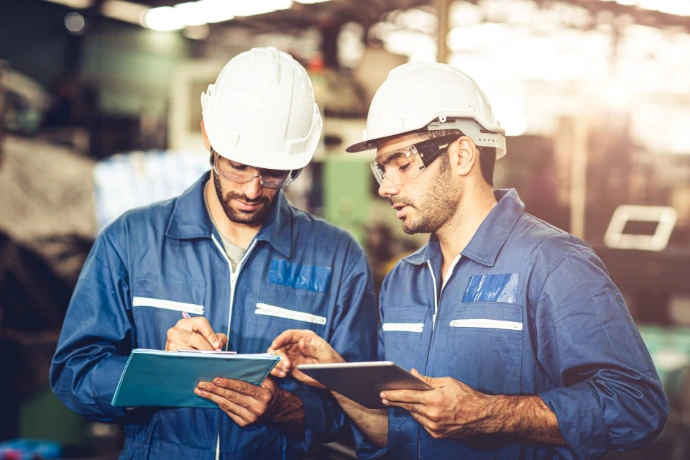
In profile cutting processes, accurate material management is essential.
Software should support:
Standard profile lengths
Reusable remnants
Inventory control
This improves traceability and enables better use of available material.
Automatic calculation of angle cuts
Prepare complex profiles without manual calculations
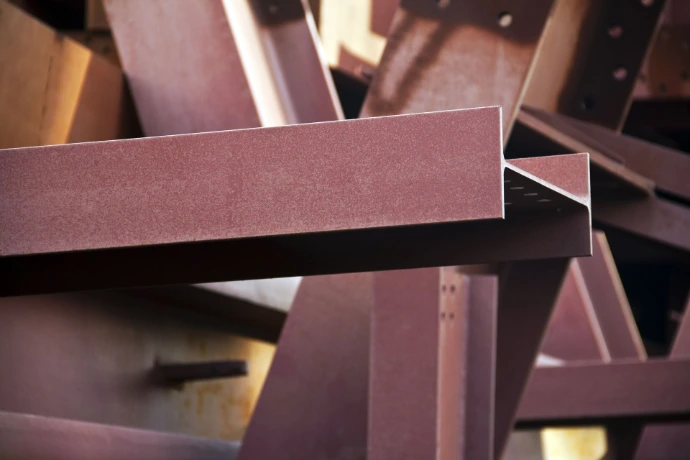
Structural manufacturing often requires angled cuts for welded assemblies. Specialized software calculates these cuts automatically and generates the corresponding CNC programs.
This reduces manual work and minimizes production errors.

Cutting process simulation
Validate operations before production
Simulation tools allow operators to visualize the cutting process before execution.
This helps to:
Validate cutting sequences
Avoid collisions
Detect errors in advance
Simulation improves process safety and reduces machine setup time.
Integration with CAD, MES, and ERP
Connect profile cutting with the entire production workflow
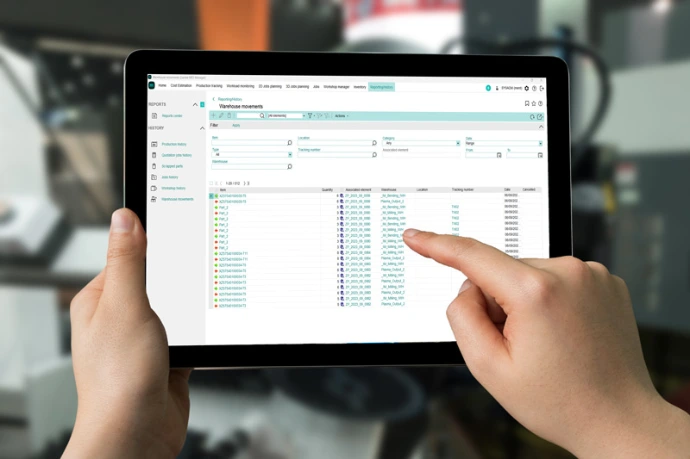
Modern sawing software integrates with plant systems.
Connection with CAD, MES, and ERP allows:
Import of designs and bill of materials
Management of production orders
Improved material traceability
This supports a continuous digital workflow from design to manufacturing.
Lantek offers
Two specialized modules for sheet metal and profile processing
Advanced software for cutting tubes and structural profiles
Design, nesting, and CNC programming in a single environment
When profile cutting involves tubes, structural beams, or complex geometries, manual programming or generic systems can limit performance. Specialized software is required to manage 3D design, profile nesting, and CNC programming within a unified workflow.
Advanced solutions support:
Design and parameterization of structural profiles
Automatic calculation of cuts and machining operations
Efficient use of bars and profiles
Process simulation with collision detection
This improves preparation time, reduces material waste, and increases production control.
Solutions such as Lantek Flex3D Steelwork provide a complete environment for structural profile manufacturing, combining 3D CAD design, nesting, and automatic CNC code generation for cutting and machining operations.
Frequently asked questions about saw cutting
We address some common questions you may have about our software.
Yes. Many industrial programming systems are designed to work with machines from different manufacturers and cutting technologies, allowing multiple machines to be programmed centrally from a single environment.
This makes it easier to program operations such as:
Saw cutting
Profile drilling
Marking
Plasma cutting or oxy-fuel cutting
For example, solutions such as Lantek Flex3D Steelwork make it possible to generate CNC programs for different types of structural profile processing machines, integrating cutting and machining operations into a single workflow.
This makes it possible to centralize programming, reduce production errors, and manage the manufacturing process more efficiently.
Yes. Specialized systems often include libraries of standard profiles such as:
I or H beams
U or C profiles
L angles
T profiles
Square or round tubes
This allows cutting, drilling, and marking operations to be prepared quickly, without having to model each profile from scratch.
Yes. Many programs allow information to be imported from structural design software using formats such as DSTV, SAT, or CAD files.
This simplifies the transfer of information from engineering to production, avoids interpretation errors, and reduces preparation time.
Yes. Advanced systems can automatically calculate angled cuts, bevels, and complex geometries in structural profiles.
This is especially useful in metal structure manufacturing, where profiles must be prepared for welded assemblies.
Yes. Profile processing software can program multiple operations on the same part, such as:
Saw cutting
Profile drilling
Marking for assembly
Milling or machining
This allows complete structural parts to be prepared from a single programming environment.
Yes. Optimization systems automatically organize parts within the available material lengths.
This helps reduce profile waste, reuse remnants, and improve material utilization.
Yes. Many systems include simulation of the cutting and machining process.
This allows users to visualize operations before running them on the machine, check toolpaths, and detect possible collisions or errors.
Yes. In digitized industrial environments, the software can integrate with ERP and MES systems.
This connects cutting operations with:
Production orders
Material management
Job planning
This improves traceability and control of the production process.
Digitizing the cutting process improves workshop efficiency by:
Reducing programming time
Increasing part accuracy
Improving material utilization
Lowering the risk of production errors
It also supports the connection between design, planning, and manufacturing.
This type of software is common in companies that work with metal structures or profile processing, such as:
Metal structure manufacturers
Industrial manufacturing workshops
Heavy machinery companies
Frame and chassis manufacturers
Energy or shipbuilding companies
In these environments, the software helps automate processes and improve workshop efficiency.