Manufacturing software for agricultural machinery
Produce agricultural machinery with better production control and less room for error.
Challenges in agricultural machinery manufacturing
Agricultural machinery manufacturing covers the design and production of equipment used in farm mechanization, from tractors and harvesters to seeders, plows, trailers, and implements. It combines large metal structures with precision components that must withstand dust, moisture, vibration, and heavy use in the field.This requires close coordination between engineering, production, and quality control within a connected manufacturing environment. Without specialized software, managing variants, traceability, and cost control becomes more difficult and reduces flexibility on the shop floor.

Large structures and complex logistics
Tractors, harvesters, and trailers require thousands of large and heavy parts. Logistics management, intermediate storage, and phased assembly are essential to maintain production flow and meet delivery dates.

Customization for each market
The same agricultural machine may have several configurations depending on the country, crop type, or local regulations. Digital management of product variants is key to reducing errors and maintaining consistency in manufacturing.

Extreme structural requirements
Frames, blades, plows, and hydraulic arms must withstand demanding working conditions. Material selection, thickness control, and the quality of cutting and bending directly affect machine performance in the field.

Global regulations and complete traceability
Each part must be identified by batch, drawing, and production order. Traceability supports quality control, safety, audits, and certification in international markets.

Multi-technology productive environments
A single plant may combine laser cutting, plasma cutting, oxy-fuel cutting, punching, and bending. Coordinating these technologies within one system is essential to maintain production capacity and cost control.

Material cost control
Steel and other raw materials have a strong impact on manufacturing costs. Good use of sheet metal and profiles through advanced nesting and scrap control is key to protecting margins.
What should software for agricultural machinery manufacturing include?
The variety of parts, the need for customization, and strict resistance requirements make generic software insufficient. Agricultural machinery manufacturers need software built for this type of production.
CAD/CAM connected to production
Direct compatibility with 2D and 3D models to convert designs for frames, blades, cabins, and hydraulic arms into cutting, punching, and bending programs ready for production.
Real-time MES
Monitoring of orders, materials, machines, and operators on the shop floor. It supports production phase management, helps detect incidents early, and supports delivery performance in demanding manufacturing environments.
Traceability and certification
A digital record of each part with its batch, drawing, and production order. This is essential for audits, international regulations, and later maintenance of equipment in the field.
Material use in sheet metal and profiles
Good material use is essential when manufacturing agricultural machinery and auxiliary components. Nesting, scrap control, and planning by thickness and format help reduce waste and control cost per unit.
Industrial ERP connected to manufacturing
Modular planning for purchasing, inventory, costs, and manufacturing, adapted to global projects with suppliers and plants in different locations.

Variant and version control
The same tractor or harvester may require several configurations depending on the market and customer. The software must control versions, maintain consistency in production, and prevent assembly errors.
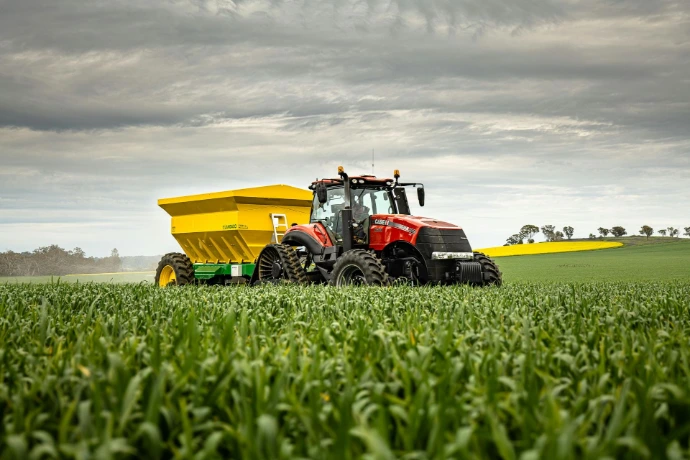
Digital solutions for agricultural machinery
Agricultural machinery manufacturing combines large metal structures with precision components that must withstand years of work under extreme conditions. From tractors and combines to planters, plows, and farm trailers, digitalization has become the key to improving efficiency, ensuring traceability, and reducing costs in a sector where reliability is everything.
CAD/CAM for agricultural equipment
Import of 2D and 3D drawings, nesting, and generation of cutting, punching, and bending programs for frames, blades, cabins, and large structural parts.

Real-time MES for agricultural production
Control over machines, operators, and work orders. It helps manage critical manufacturing phases and support delivery dates, even in large production projects.

Industrial ERP connected to production
Purchasing planning, stock management, and cost control linked to manufacturing. This is important for coordinating international suppliers and distributed plants.

Manufacturing analytics and production analysis
Tools for working with plant data in a practical way, including scenario analysis, bottleneck detection, and better use of available resources.
Key manufacturing processes
Agricultural machinery manufacturing involves thick sheet metal, structural profiles, and precision parts. From tractor chassis to harvester blades and seeder frames, each component must be produced with strength, consistency, and traceability to withstand intensive field use.
Laser cutting
Used for parts that require precision and good surface finish, such as cabin panels, supports, covers, and assembly elements in tractors and harvesters. Laser cutting supports repeatable cuts in medium-thickness sheets and helps reduce waste.
Plasma cutting
Widely used for large structures and thicker materials, such as trailer frames, plow arms, and harvester reinforcements. It offers a good balance between speed, cut quality, and cost.
Waterjet cutting
Used for composite materials, technical joints, or heat-sensitive parts where the material properties must remain unchanged. It is suitable for specialized or high-value components.
Automatic bending
Essential for forming frames, fenders, tanks, structural reinforcements, and chassis profiles. Bending accuracy ensures correct fit during final machine assembly.
Oxy-fuel cutting
Recommended for very thick chassis parts, anchors, and support plates. It remains an important process in the manufacture of heavy agricultural machinery.
Punching
Suitable for ventilation grilles, perforated supports, trays, and covers. Its ability to perform several operations in one process makes it useful for serial parts and repetitive geometries.
Proven solutions in the field
Frequently Asked Questions (FAQs)
Industrial software is used that combines CAD/CAM, production management, resource control, and cost analysis on a single platform.
The manufacture of tractors, harvesters, and agricultural implements combines large structures with precision parts. The system must convert 2D and 3D models into production processes, improve the use of structural steel, and maintain traceability by model and customer. In this context, vertical solutions such as Lantek support specialized metal manufacturing in the agricultural sector.
Through digital control of configurations and design versions.
The same model may require different configurations depending on the country, crop, or local regulations. A structured system allows different versions to be produced on the same line without duplicating processes or causing assembly errors.
Through automatic nesting and analysis of actual material consumption.
In frames, chassis, and structural arms, steel represents a significant share of total cost. Advanced CAD/CAM software helps improve the use of sheet metal and profiles, reduce waste, and improve margin per unit produced.
OEE, actual material consumption, cycle times, cost deviation by model, and deadline compliance should be monitored.
These metrics help measure production performance and competitiveness. Shop floor data capture is essential for detecting bottlenecks and improving planning.
By centralizing planning and production data on a shared platform.
Global demand requires coordination between suppliers and distributed production sites. A digital system provides real-time visibility of orders, materials, and production capacity.
By directly connecting engineering models with the CAD/CAM system and plant planning.
This avoids manual reinterpretation of drawings, shortens programming time for cutting and bending, and reduces errors before production starts.
By recording each part and subassembly with its material batch, production order, and model.
Traceability supports audits, warranty management, and later field maintenance. A structured digital system makes it possible to identify which components belong to each manufactured machine.
Yes. It should work in multi-technology and multi-brand environments.
In an agricultural machinery plant, laser, plasma, oxy-fuel cutting, punching, and bending from different manufacturers often coexist. The software must generate machine-specific programs without depending on a single brand. Platforms such as Lantek are designed for this type of manufacturing environment.
Because agricultural machinery manufacturing requires technical production processes that a generic ERP does not cover.
Advanced nesting, multi-machine programming, variant management, and model traceability are part of the production core. Vertical software for metal manufacturing complements ERP and manages the technical layer of production. In this area, solutions such as Lantek are designed for agricultural machinery manufacturers.