



Geometric creation for cutting parts
The drawing environment enables the creation of complete 2D geometry, including lines, arcs, circles, polygons, grooves, and standard industrial shapes. Geometry is structured from the beginning for machining, simplifying the assignment of cutting technology and sequences.
Advanced lead-in and lead-out management
The module includes full control of lead-ins and lead-outs, with automatic, semi-automatic, and manual options. Users can define how the tool enters and exits each contour to improve edge quality and part stability.
Micro-joints and part holding strategies
Micro-joints are defined during design. The system allows different types of fixtures, nano-joints, and parameterized micro-joints to maintain part stability during cutting and reduce deformation.
Loops and corner control
Automatic loop generation, edge rounding, and vertex control improve cutting quality in critical areas. Users can apply these settings globally or selectively.
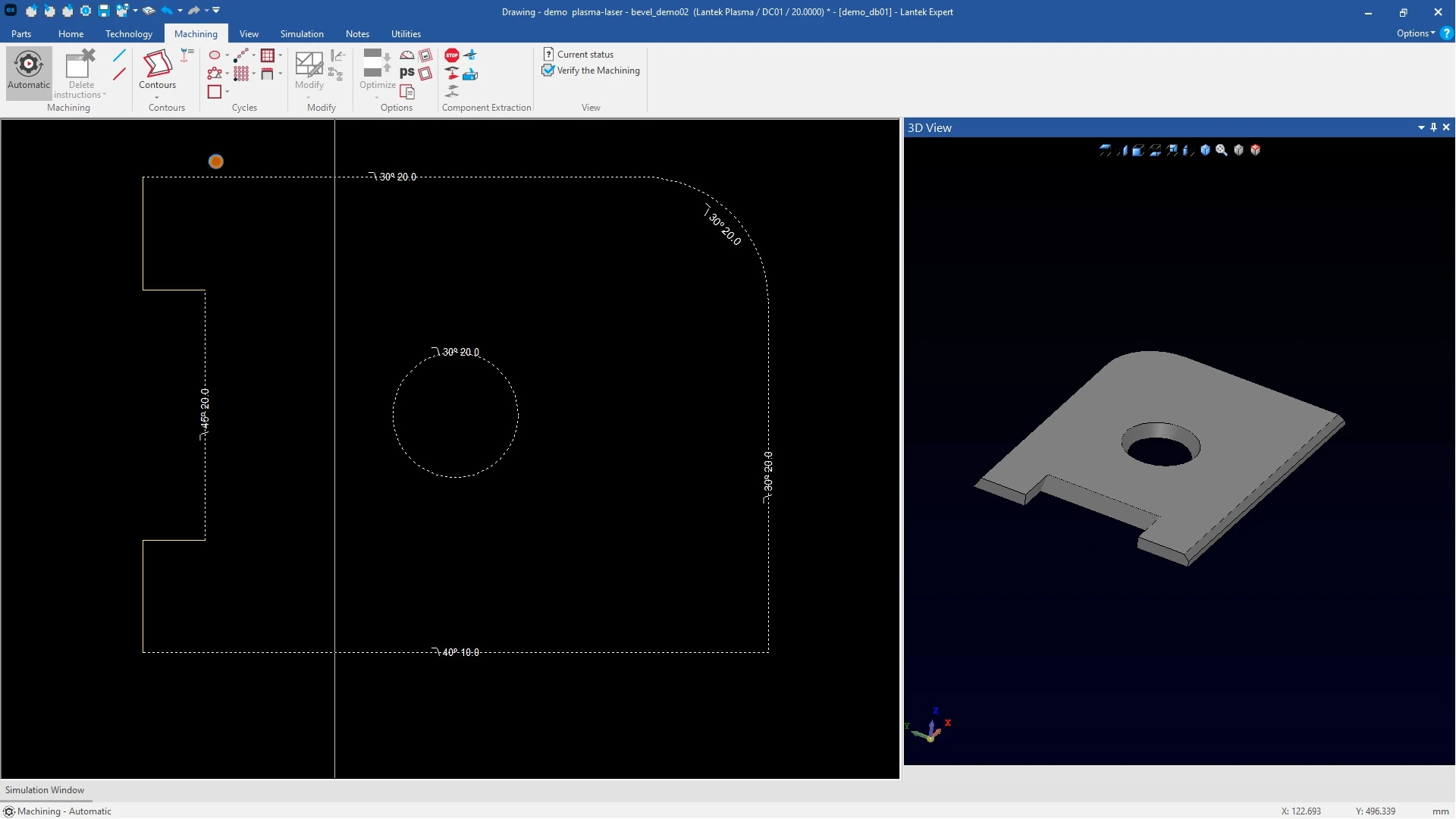
2D and 3D chamfers
The module supports standard chamfers and 3D chamfers with control over upper and lower faces and contour connections. This is essential for parts requiring welding preparation or edge finishing.
Cutting technologies integrated into design
Users can assign technologies such as marking, no-cut areas, clean cutting, or dynamic cutting directly in the drawing phase. This ensures consistency between design and production.
Automatic cycles and hole destruction
The module includes linear, circular, and irregular cycles, as well as manual, automatic, and semi-automatic hole destruction functions. These tools are designed to optimize machine times and resolve repetitive operations directly from the design. It also allows for the machining of pattern layouts and complex sequences without external programming.
Operation recognition from imported geometry
The system allows the assignment of machining operations such as drilling, threading, or milling directly on imported geometries, converting shapes into manufacturing instructions.
Dimensional compensation
Tools are available to adjust part dimensions at specific points to compensate for welding or thermal deformation. These adjustments are applied directly in the design without rebuilding the part.