There was plenty to celebrate at our stand at EuroBLECH 2026. This year, we mark our 40th anniversary, introduce the 46th version of our software portfolio and unveil our redesigned website, which went live shortly before the exhibition.
“For 40 years, Lantek has been a driving force behind connected manufacturing worldwide,” says our CEO Alberto López de Biñaspre. “We started as a CAD/CAM specialist, focusing on machine programming, and today we develop solutions for the Smart Factory, connecting an ever-growing number of manufacturing processes.”
More than 40,000 customers in over 100 countries benefit from our manufacturer-independent software portfolio, which supports more than 4,500 machine models. We also continue to expand our international presence, with local teams in 23 offices across 17 countries providing dedicated support to customers and machine tool manufacturers. Their close contact with local markets also provides valuable input for our product development, helping us respond to customers' needs.
Software update V46: more technologies, connectivity and data flow
Our strength lies in our ability to connect manufacturing processes across different machine manufacturers and technologies, ensuring a continuous flow of data. We continue to develop our software portfolio in response to industry needs, helping companies manage increasingly complex production environments with greater efficiency, flexibility and consistency.
Against this backdrop, our software update “Lantek V46: Further” attracted considerable interest among visitors to EuroBLECH 2026. The new version extends automation to additional technologies, connects more areas of the shop floor and improves the flow of information across our entire portfolio. Key developments include:
Quoting: A new generation of intelligent quotation software, with further developments in iQuoting
Punching: Advanced programming and high-performance nesting with Lantek Expert for punching machines
Greater automation throughout the production workflow with the redesigned Stackmaster
Assembly import and tab-and-slot connections for tube and profile manufacturing in Lantek Flex3D
Deeper integration of Lantek Bend
Extended machine connectivity throughout the shop floor
Over the past 40 years, our portfolio has evolved from traditional CAD/CAM and machine programming software to solutions for connected manufacturing processes, cloud applications and a Smart Factory platform. This evolution is also reflected in our new website, launched shortly before EuroBLECH. With a reorganised structure, clearer navigation and a wide range of graphics and videos, www.lantek.com presents our entire software portfolio while also providing information on manufacturing technologies and practical advice on topics such as cybersecurity.
We attended EuroBLECH 2026 in Hannover from October 20 to 23, at Hall 11, Stand 11-C08.
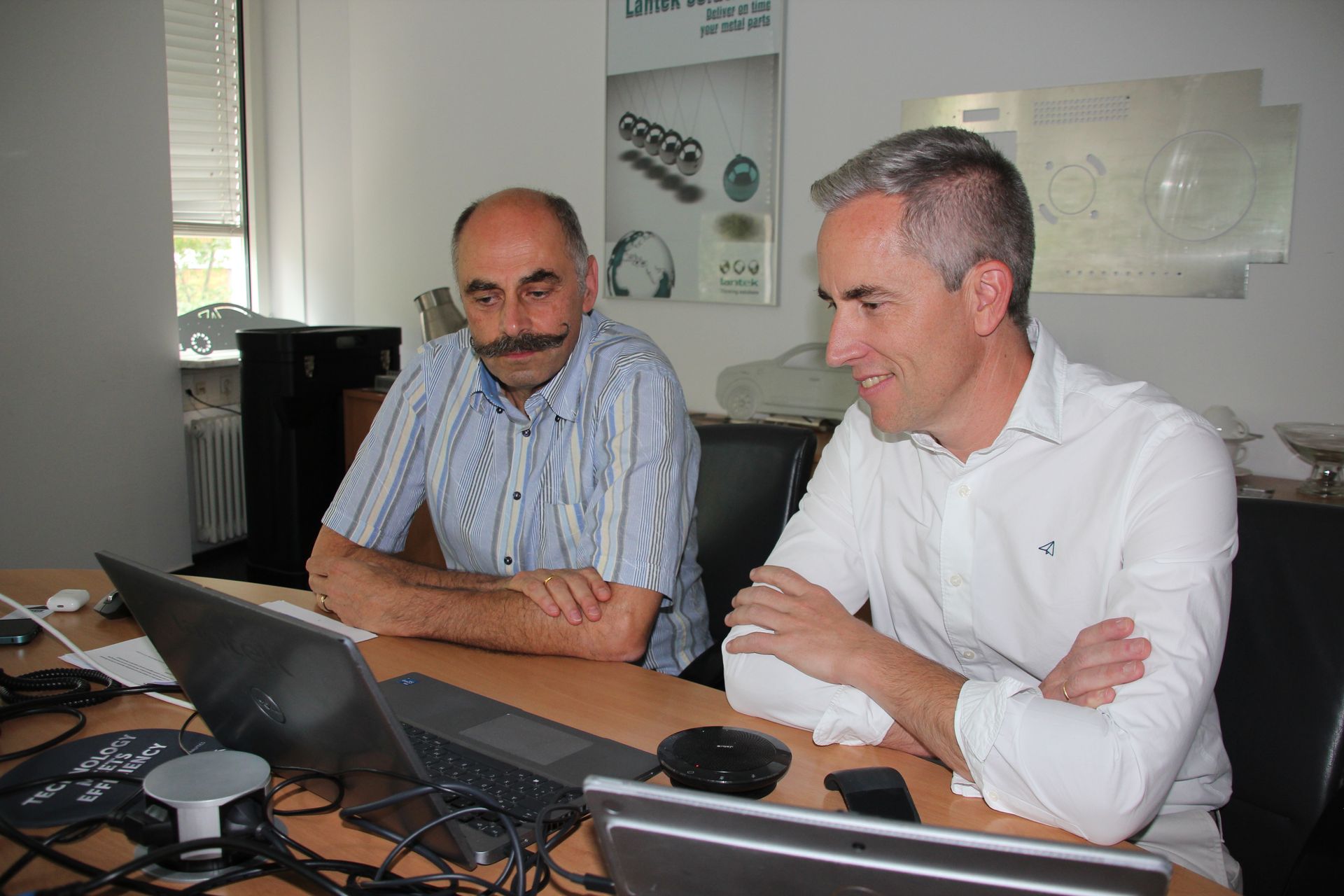
Three questions for…
Our CEO Alberto López de Biñaspre
What has made Lantek's offering unique over the past 40 years?
Many manufacturers supply their machines with their own software. From the beginning, Lantek has followed what we call a multivendor approach. We enable our customers to program machines from different manufacturers using a single software solution, while gradually digitalising and connecting more areas of their production operations.
What does the Smart Factory concept mean to you?
Our main goal is to make everyday manufacturing operations more efficient and use digitalisation to relieve users of repetitive tasks. Companies, including those in Germany, need to improve efficiency in many areas. They face international competition while also dealing with a shortage of skilled workers. As a result, we have evolved from a provider of traditional CAD/CAM software into a partner offering a platform of interconnected software modules. Each company can select the components that best support its processes, according to its own needs, all the way through to a fully digital factory. Customers' control over their data, information security and data protection are priorities for Lantek. We operate according to high standards and are ISO 27001 certified.
Where is sheet metal manufacturing heading?
Artificial intelligence will play an increasingly important role in our industry. We do not want to use AI for its own sake, but rather take advantage of the opportunities it offers. For example, it can help analyse large volumes of historical data to produce more accurate quotations or estimate values when data is missing. We also see opportunities in agentic AI, where artificial intelligence could go beyond providing individual pieces of information to supporting entire processes more extensively.
Three questions for…
Christoph Lenhard, Sales Director for the DACH region
Is Lantek only suitable for IT specialists and large companies?
Quite the opposite. Our software portfolio is modular, so every new customer can start with the module that addresses their most pressing challenge. Our team advises customers on selecting the right solution, supports implementation, trains employees and remains available afterwards to answer questions and resolve issues. Companies can then add further modules and digitalise other areas of their business as needed, at a pace that suits both the organisation and its employees.
What benefits does this offer companies?
First, our manufacturer-independent, multi-technology approach gives companies the freedom to choose new machines and technologies without being restricted by the software supplied with them. Second, they benefit from connected processes and a continuous flow of data. Accurate information replaces Excel spreadsheets and decisions based on gut feeling. Once data has been entered, it can be used across different processes within the software environment, from costing and quotation preparation to manufacturing. This reduces data transfer errors, saves considerable time and increases visibility across operations.
How do you assess the current situation in the German market?
Companies are more cautious about investing. While the focus used to be on expanding capacity by purchasing new machines, today the priority is increasingly on improving efficiency. Digitalisation still offers considerable opportunities in many companies. By using data, connectivity and automation, they could make better use of their existing resources.