
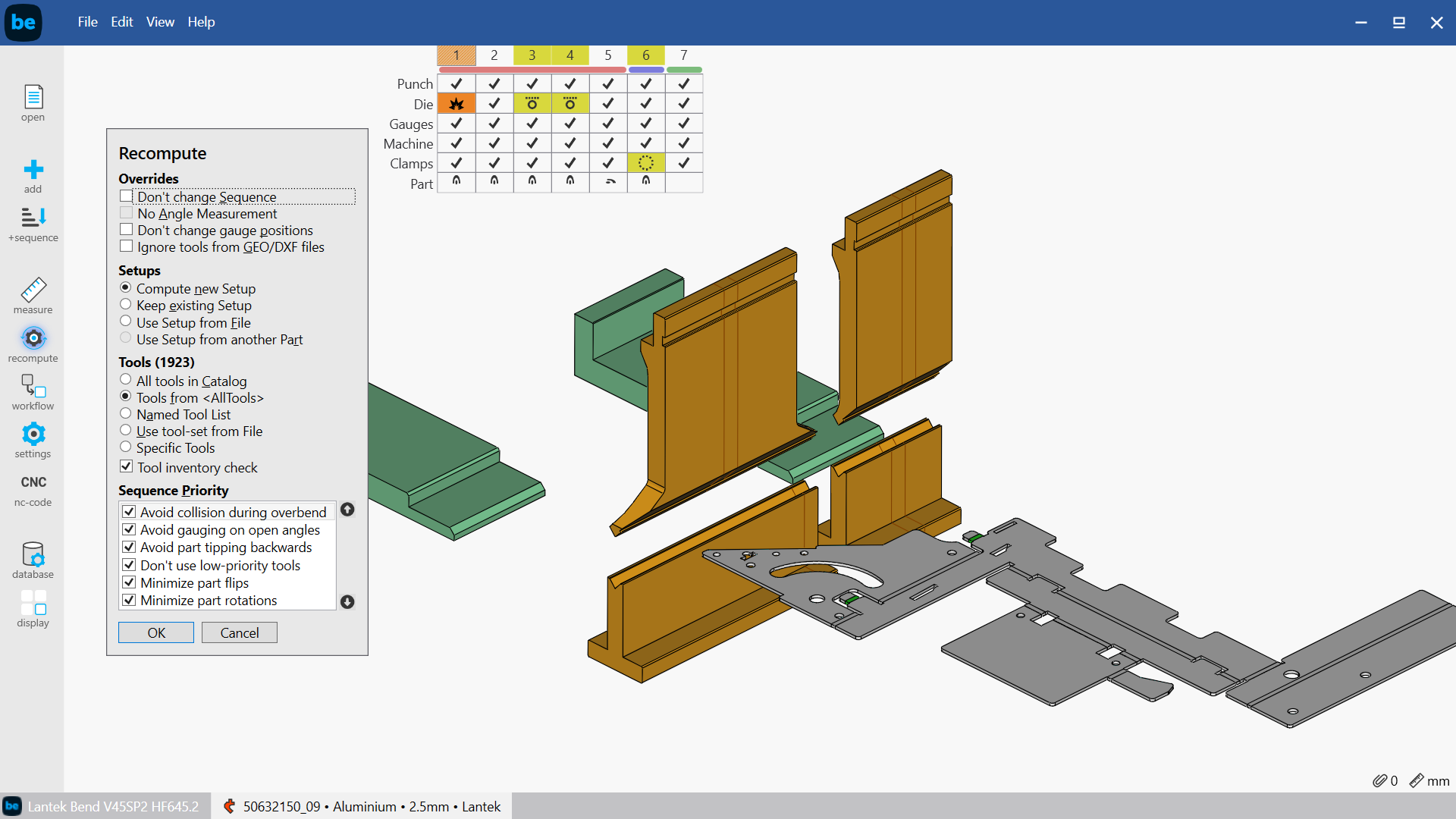
With the latest evolution of the solution, Lantek strengthens connectivity between cutting, bending, MES and ERP processes. Lantek Bend is now fully integrated into the Lantek software suite, allowing information to be exchanged seamlessly with upstream and downstream systems throughout the production process. This digital continuity helps unify workflows and reduce manual data transfers between disconnected applications.
Designed to simplify bending machine programming, Lantek Bend has evolved to provide greater automation capabilities and deeper integration with the rest of the Lantek ecosystem.
Fully Integrated Within the Lantek Suite
The solution includes a bend deduction management interface, automatically identifies different bending operations and selects the appropriate tooling for each simulation. This enables consistent and repeatable calculations, even in production environments operating machines from different manufacturers.
The application also features a redesigned user interface with a modern look and feel, together with customization options for OEM partners, making it easier to adapt to different working environments.
Accurate and Consistent Bending Calculations
Users can bring a 3D geometry into the Lantek suite in several ways. They can open the model in Lantek Expert to generate the flat pattern and then send it to Lantek Bend, or import the geometry directly into the bending environment.
Once the part has been loaded, users can edit it, simulate the bending process and generate all the information required for manufacturing. The system also helps identify potential design issues, validate whether the geometry is suitable for unfolding and apply corrections when necessary.
To ensure calculation accuracy, Lantek Bend uses the customer’s own material data, tooling information and production history. The software includes a bend deduction calculation interface available for all installed machines and performs calculations using Finite Element Method (FEM) technology.
Users can choose from different flat pattern and bend deduction calculation methods and access specialized databases, including the Trumpf database, which contains approximately 8,000 validated tests covering a wide range of machine and tooling configurations.
The software also includes a library of more than 7,000 tools, dies and special tooling components. Calculation parameters can be adjusted according to each company’s accumulated experience and manufacturing requirements.
Every new scenario added to the system, including tooling, geometry, angle, radius and bend deduction values, contributes to refining the calculation models. As more data and production experience become available, prediction accuracy continues to improve.
Managing 3D Parts with End-to-End Data Continuity
Lantek Bend enables users to store and reuse information through import and export functions. The data and documentation generated during the process are automatically linked to the part record and can be shared with other applications within the suite, including Lantek Expert, Lantek MES and Lantek Integra.
When an active manufacturing order exists in Lantek Expert, the calculated part is automatically incorporated into the corresponding production job, ensuring information continuity throughout the manufacturing process.
Through this integration, sheet metal manufacturers can manage both 3D part processing and information flow within a single software environment, reducing issues caused by disconnected systems, version mismatches or incomplete production plans. The result is a more consistent approach to data management, from quotation and engineering through to final production.