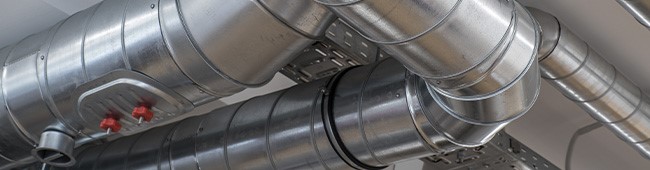
Applications can be complex, where fume extraction, odour extraction or large-scale ventilation is required. These systems can be very large and need to be robust and leakproof to provide a safe workplace for employees as well as for protection of the surrounding environment. The dedicated design requirements require an individually specified solution which requires custom built ducts and fittings.
More challenging requirements can include high pressure ductwork and harmful or potentially explosive dust and nuclear applications. For these situations, the quality of the individual components and how they fit together is crucial to the success of a project.
Within the Expert Duct system there are 191 different duct figures for items such as elbows, tees, round-to-square connectors, etc. However, most companies only regularly use about 10-15 of these figures, so users will find that there are plenty of options available to suit their requirements. Where there is a need for special shapes these can be created for the customer.
The duct figures always start as a 3D model which can be previewed to check that they are the desired shape. They are then automatically unfolded to produce the 2D shape for laser or plasma cutting. Where new duct figures are created for particular clients, these are added to the database of standard shapes, adding to the flexibility and range of the system. The advantages for engineers are that it is easy to add the duct dimensions for each component in a job and, as the unfolding is automatic, significantly reduces the chance of an error.
Once the 2D duct shapes have been prepared, they go straight into Lantek Expert for nesting, which optimises material usage and reduces waste. CNC code to suit the customers individual machine, irrespective of its make, model or type, is then automatically generated in Lantek Expert for cutting and marking the material, ready for manufacture.
The forming of the finished duct from the 2D cut shape is a complex task and needs to be done with care. To help the manufacturer complete it correctly, the system has a range of marking options for the folds. These include long marking lines along the folding lines, short marking lines at the beginning and ending of the folding lines, point marking along the folding lines and notches at the beginning and end of folding lines.
Every 2D developed figure manufactured is stored in Lantek’s database so that it can be reused for another application, or its dimensions altered to produce a slightly different shape. The configuration of the customer’s Expert Duct system is also stored so that it can be reused every time, speeding up the manufacturing process even more.
With the addition of Lantek MES, data about each job such as sales order number, material, the machines used for manufacture and the required delivery date are recorded. This information helps in production planning and costing, keeping track of performance for quality, on-time delivery and profitability. Additionally, it makes for easy traceability for every component in a ductwork assembly, a requirement which is increasingly important in supply chains, making it possible to go right back to the batch of material used for each part.
With Lantek software, ductwork manufacturers will have a complete solution starting with the design and unfolding of complex ducting shapes, through costing, quoting, cutting and on to the marking of folding guides. In addition, it offers systems which control the whole production process, raising the efficiency of machinery and keeping track of production in real time, enabling the delivery of high quality and cost effective projects on-time and within budget.