In today’s world, one of the few sectors which cloud computing has not penetrated on a large scale is in industrial plants. Many companies are still wary of a remote platform which operates from outside their facilities, despite its undeniable success in other economic sectors and the tremendous advantages it offers.
Editorial of Juan José Colás, Chief Sales and Marketing Officer
Of course, the Digital Transformation of industrial companies is changing this dynamic, because data capture devices and software tools are becoming more interconnected. The need for computers to relate and obtain valuable information that facilitates decision making is increasing every day, and access to this information is no longer reduced to a personal computer in an office, but to multiple devices.
In this context, companies are turning to cloud computing because of all the advantages it offers: an immediate increase in computing capacity, no hardware or software obsolescence, no need for investment in fixed assets, no costs of excess capacity, no need to increase the number of specialized technicians, and the peace of mind offered by advances in security and multi-location which ensure that corporate data is more secure than on a company’s own servers, among other benefits.
All these points are essential competitive advantages in a hypercompetitive world. Therefore, the most important cloud platforms (Azure by Microsoft, AWS by Amazon and Cloud Platform by Google) are growing exponentially and many industrial companies are going to take this step in the coming years.
Digital competitiveness will be the fundamental factor in the survival of many companies. Welcome to the new reality.
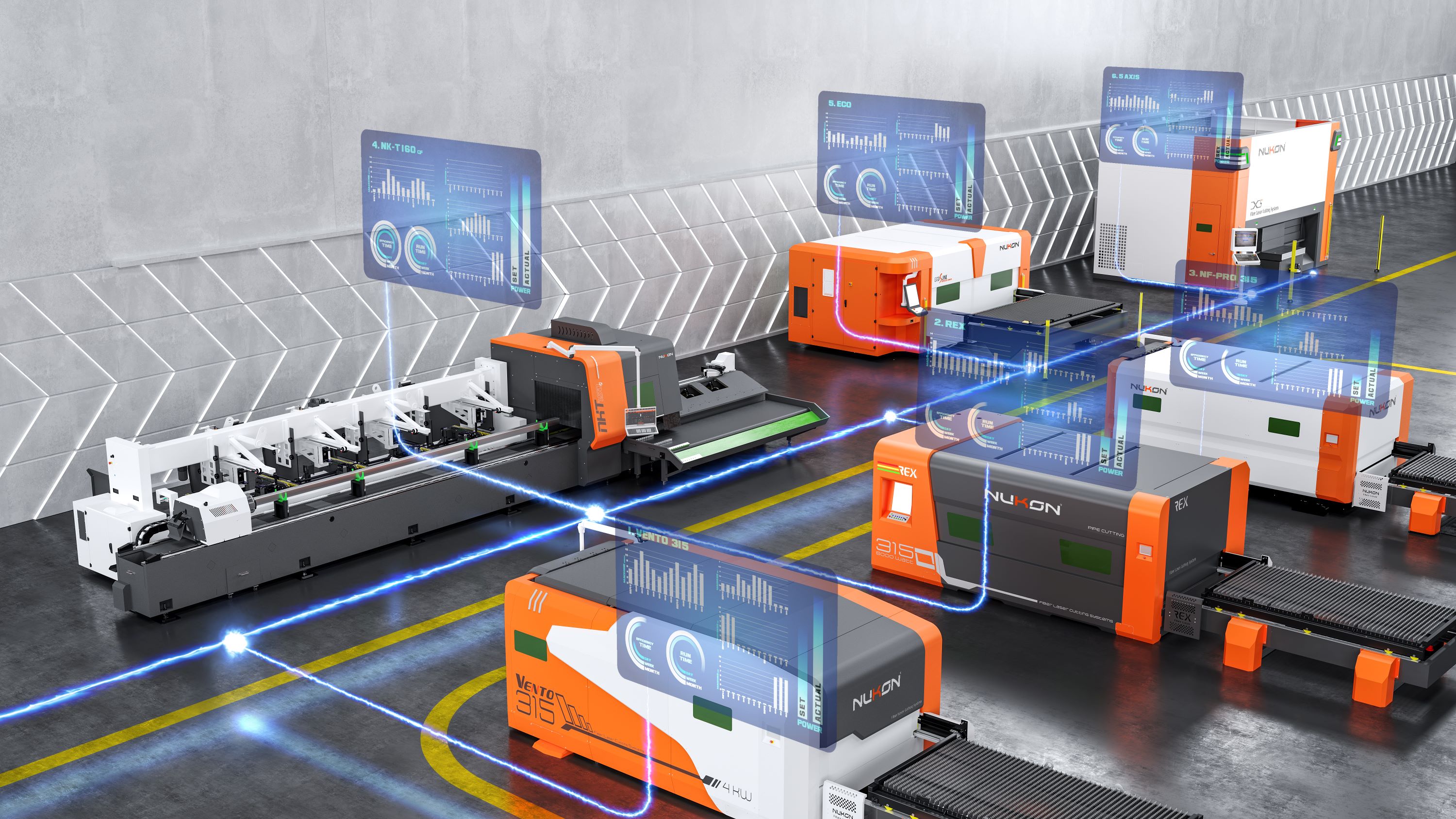
Premium Turkish laser manufacturer Nukon is one of Lantek’s OEM collaborative partners, combining the 2D and 3D technology of Nukon’s lasers with the expertise Lantek brings to the industry with its Lantek Expert software for programming 2D lasers and its Flex3D software for tube cutting lasers.
Cutting and bending sheet metal accurately is a challenging task, especially when the job involves tight tolerances and complex geometries. It often takes time, skill, and multiple tries to meet customer specifications.
In this era of pandemic, connectivity has shown just how valuable it is. Following lockdown, manufacturers adapted their workflow and the way they operated in order to continue producing. Those that were able to work remotely did so to maintain safety distances. But... what are the differences between factories with varying levels of connectivity?