
That approach worked while the context allowed it. The context is no longer the same.
Industrial subcontracting now moves at a speed that leaves little space for improvisation. Customers often send the same drawing to several suppliers and expect a quotation within hours. Price remains a decisive factor, but consistency is just as important. A competitive quote that fails to reflect the real production cost creates problems later in manufacturing. A quote that plays it too safe rarely turns into an order.
The information challenge
The difficulty does not lie in the capabilities of sales teams. The real limitation is the information available when a quote must be prepared.
A well known paradox exists in this sector. The price is defined before the production process exists. Key factors such as material utilization, nesting strategy, combination with other jobs, the actual scrap percentage or the real machine time directly affect the final cost. These elements are normally defined later, once the quotation has already been sent.
At the quoting stage, sales teams rely on past references, personal judgment and often spreadsheets that simplify a production reality that is far more complex. For many years this has been accepted as part of the profession. It is also one of the areas where risk tends to concentrate.
Supporting quotes with real production data
In workshops that have already advanced in digitalization, the data is already there. Production and management solutions from Lantek, widely implemented across the industry, capture what actually happens on the shop floor every day. They record how parts are nested, the material yield achieved and the real machine times generated in production.
The challenge is not capturing this information. The challenge is using it earlier, at the moment when the process is not yet defined and the quotation still needs to be sent.
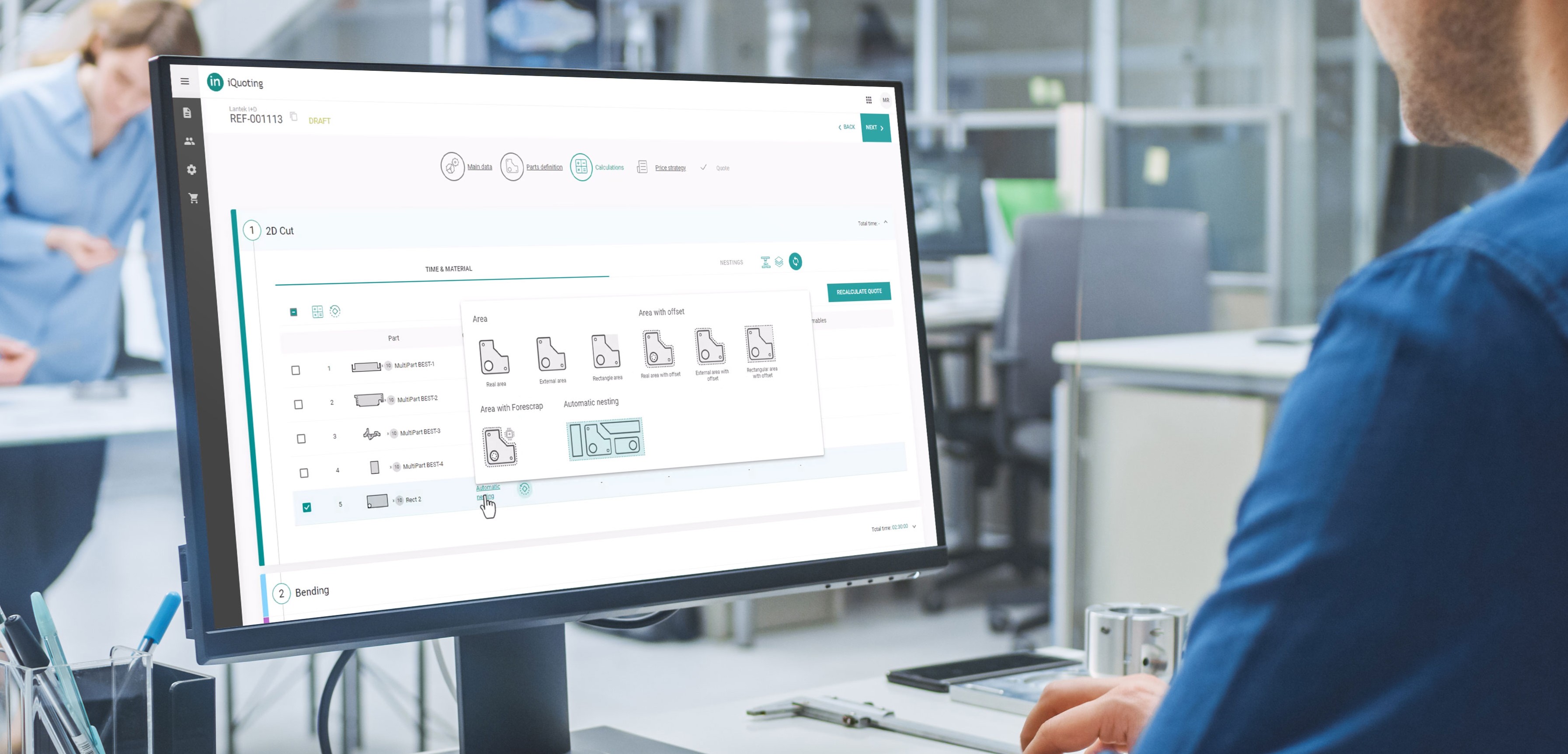
Lantek iQuoting was created with a clear objective. It helps sheet metal companies digitalize the quoting process with a low financial and operational impact while allowing teams to respond faster and with less internal friction. As part of that evolution, more advanced calculation approaches have been incorporated when they add value, including models that learn from real production data.
The platform combines several ways of estimating costs at early stages. These include business rules, calculation models based on the production process itself and, when sufficient information is available, machine learning models trained with real manufacturing and sales data.
When historical data is limited, the system relies on parameterized models and criteria defined by the workshop itself. This makes it possible to start quoting from the first day and gradually improve accuracy as new operational data is generated. Artificial intelligence therefore acts as an additional capability rather than the foundation of the system.
The objective is straightforward. Provide sales teams with an objective reference that reduces uncertainty at a critical moment. That moment arrives when a price must be decided even though several technical decisions have not yet been made.
In tests carried out with industrial customers, this approach has reduced the deviation between quoted prices and real production costs. The improvement is particularly visible in environments with high workloads and tight response times. Quoting time decreases and variability between similar offers becomes lower.
Every workshop operates differently
Each sheet metal workshop works with its own mix of machines, processes and internal criteria. Market conditions also vary, even between companies operating in the same segment. Any quoting solution must start from that diversity rather than ignore it.
In workshops where iQuoting is already part of daily operations, the impact appears mainly in everyday work. Customer responses become faster. Companies depend less on very specific profiles. Risk becomes easier to manage when accepting jobs whose real cost used to appear only later in production.
Quoting sheet metal work will always require professional judgment.
The difference today is that this judgment can rely on real and structured information that reflects what actually happens on the shop floor. And it becomes available at the moment when it matters most. When the price must be decided.