Now, in the fourth industrial revolution, based on digitization (cyber-physical systems, Internet of Things, Big Data, Cloud), it will be no different. The opportunities for growth and productivity are highly attractive, but it’s also true that it implies a virtually infinite and constantly expanding world of new technologies: a new sensor, new analytical software or a new machine tool. The Industry 4.0 landscape changes from one day to the next, and we must be prepared so that we can adapt quickly to changing conditions.
Given the countless business challenges and the vast availability of new technological tools to address them, the number of potential solutions for creating value is set to grow exponentially.
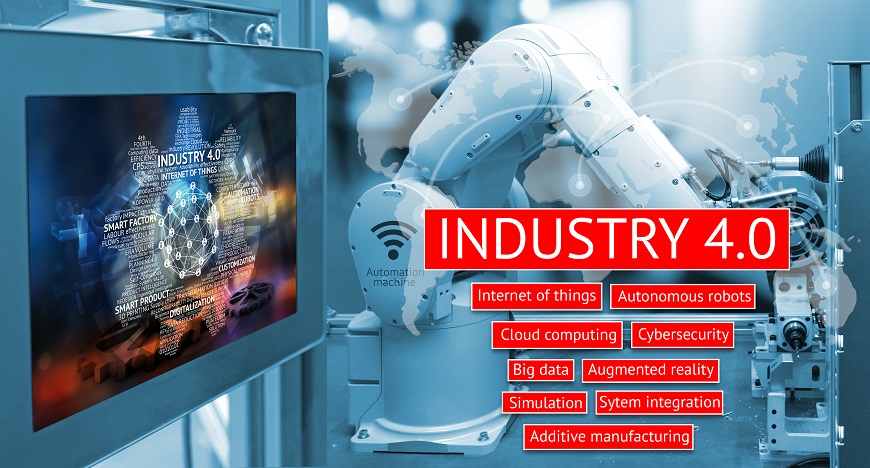
It’s a good idea to be accompanied by experts who help SMEs on their journey towards Industry 4.0 and make the Digital Smart Factory a reality. Let’s take a look at the 9 pillars of Industry 4.0 highlighted by the Boston Consulting Group to see how we can improve our sheet metal cutting factory:
The Internet of Behavior, IoB, consists in capturing, collecting and analyzing a large amount of data from different sources to support decision-making processes. By crossing historical and current data, software with algorithms based on Artificial Intelligence and Machine Learning can detect behavior patterns that help us, for example, to anticipate subsequent peaks in demand or, in contrast, foresee a possible decrease in consumption so that we can take corrective measures. Likewise, there are programs that aim to improve plant efficiency. The use of AI in CAD/CAM software makes it possible to reduce the generation of scrap using machine learning to optimize the placement of the pieces to be cut.
The new generation of robots will cost less and have greater capacity than those currently in use, they will be able to interact with each other and with people and learn from these interactions.
The use of simulation systems will be extended to all production processes to process data collected in real time in virtual models in order to test and optimize machines, products and processes and anticipate problems before they occur. For example, machine tools already feature advanced software that allows us to compare 3D machining simulation models from numerical control with files created in CAD/CAM.
The integration of data and systems along the entire value chain ensures that all of the company’s departments and functions are part of a single integrated system. This integration makes it easier to draw conclusions as we no longer see the organization as isolated sections, but as what it is: a complex system which is, in turn, made up of multiple complex systems.
This is the set of technologies and sensors that will allow objects in the factory, both devices and finished products, to communicate and interact with each other and with people through the network. This way, data analysis and decision-making are decentralized, enabling real-time responses.
With increased connectivity between devices, the need to protect factory production systems and the IT network from potential threats using cybersecurity programs will also increase. This point is all too often forgotten, but it’s important to think about it right from the outset instead of only considering it once a major incident has already occurred.
Many companies are already using cloud-based applications, but in Industry 4.0 a greater exchange of factory data will be required meaning that production control and management applications will also need to be available. Because the new technological enablers are implemented in the Cloud. At Lantek, we focus on SaaS access (Software as a Service), to open the door for SMEs to services and software that they can use to optimize their plants to the extent that suits them.
At the moment, 3D printing is used for prototyping or for producing specific components, but in Industry 4.0 these additive manufacturing technologies will be used more widely to produce highly-customized batches of products. Technology makes previously unattainable geometries possible, paving the way for users to improve and refine their parts. What’s more, additive manufacturing only deposits the material where it is really needed, this makes the 3D printed parts lighter and, furthermore, any excess powder can be reused. It’s certainly a more economical and sustainable approach than conventional processes, such as milling, in which up to 80% of the material is wasted, according to Trumpf.
These are systems which, using mobile devices, through sight (for example, projection lenses on the retina), sound (headphones) or touch (gloves), add multimedia information to people’s perceived reality. These technologies will be used to provide real-time information to improve work processes and decision-making. For example, the Lantek Touch&Play application means that, thanks to cameras inside the cutting machine that detect metal parts, an operator can carry out tasks with a simple dragging motion, facilitating maximum utilization, material usage and improving times and costs.
The benefits of Industry 4.0 can be listed as follows:
At Lantek, we’re working to help and accompany SMEs in their digital transformation process to make the Digital Smart Factory a reality by developing advanced software based on data analytics and in the cloud. Call us, with no obligation, and let’s set off on the journey towards Industry 4.0 together.