This already complex decision is made even more difficult by the fact that the market has gradually become saturated with suppliers offering these products and that, in some cases, they prioritize sales by price, that is, quick and "cheap" sales, rather than the authentic performance of the machine.
We’re going to try to highlight some key elements that should be taken into account when purchasing a laser cutting machine, although it goes without saying that there are no general rules that work for everyone. Each company has to consider a good number of factors before choosing one solution over another from the many machines that, as we already mentioned, are currently available on the market.
The first doubt to be cleared up: CO2 laser or optic fiber laser? And the answer is: it depends on how you’re planning to use the machine and, what’s more, the two technological solutions are not exclusive. Although the technical differences between optic fiber and CO2 are many and varied, the main difference between one technique and the other is that CO2 technology is more suited to large thicknesses and obtains better cutting qualities with certain materials, although fiber laser is exponentially increasing its ability to cut greater thicknesses every day.
Fiber laser adds other advantages, such as high cutting speeds and lower production costs, lower energy costs, and even a cheaper maintenance service than CO2 laser.
There are other factors to take into account when purchasing a laser machine, such as the number of heads it will have. Depending on the type of work you do, it can be very useful to use two heads at the same time, achieving double the productivity.
Another characteristic that needs to be considered when carrying out a needs analysis is whether we should choose a straight cutting head or one equipped with a beveling system for cutting pieces with bevels. Not all manufacturers offer this possibility or the one with the double head mentioned previously.
To these factors and the many others that we could also discuss, we can add the different automation options that are increasingly included with laser machines and that are worth highlighting.
We could talk about evacuation and/or palletizing systems for the pieces, an interesting solution for unattended and automated production, to which the automatic loading of sheets can be added to turn the laser machine into an autonomous system.
The alternative solution of integrating an automatic sheet metal feeding system using a metal coil is also an interesting option. We also mustn’t forget what we call laser blanking, a technique that makes it possible to cut the pieces in an automatic and continuous way, achieving greater efficiency in the production process for the same thickness and width of sheet metal.
At the moment, the market is moving in two directions that are not mutually exclusive:
In any case, buying a laser cutting machine is a big step due to its cost, so other considerations should be taken into account to avoid making mistakes in the final choice.
The best machine in the world is a bad investment if it’s not the one that suits my company. The best machine in the world is a bad decision if I’m not going to make a profit from using it, or if I’m not ready to use it, or if it requires maintenance that I cannot afford or replacing the parts is a complex process.
That’s why it’s essential to be clear about the specific objectives that I want to achieve with the laser cutting machine before choosing between one model or another.
Our fundamental objective must be to improve the quality of our products and also reduce costs, and this involves adapting the infrastructure to the real needs of our plant, together with the response capacity that we have as a human team.
We cannot lose sight of the fact that a laser cutting machine must last for a long time, and that to do so it needs a suitable environment and adequate conditions. If we fail to provide these, the useful life of our machine could be jeopardized and, along with that, we could lose our investment.
And speaking of investments, the laser cutting machine will require subsequent investments in different areas on a permanent basis, investments that, a priori and logically, are difficult to quantify.
Among all of these considerations there is one that is fundamental and that is the importance of after-sales service. Having a laser cutting machine that is profitable is directly linked to being able to use it for as long as possible. Any machine downtime for reasons beyond the control of the company is obviously a loss in terms of both time and money. Subsequently, having adequate maintenance and the best possible service in any eventuality is an aspect to be evaluated and one which is at least as important as the machine itself.
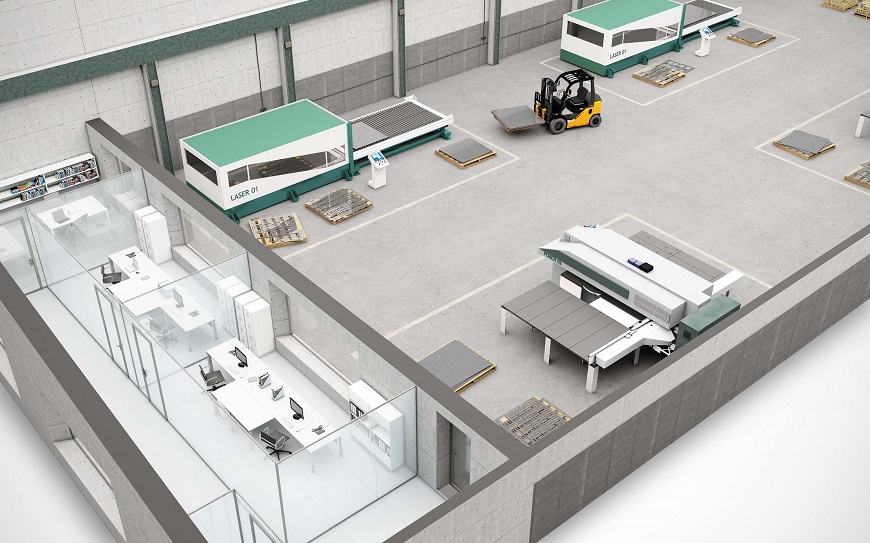
Additionally, in plants where several cutting machines coexist, this situation becomes even more complicated, if that were possible. The newly acquired machinery isn’t always made by the same brand as the existing machines or uses a different type of technology.
It’s also quite common for clients with oxycut and plasma machines to expand their production by purchasing a laser cutting machine.
In addition to this, along with the problem of having qualified personnel to handle these machines we also need to bear in mind that each manufacturer supplies their machines with different software.
Obviously, the biggest problem arises when several machines of different brands and technologies are mixed together in one production, a situation which is all too common. All of this can make many companies reluctant to change their technology and, above all, they restrict themselves in terms of changing machine brands. Obviously, brand dependence is not only a problem in terms of software, but also for spare parts, tools, etc., but software plays a key role as well.
There are several advantages to having software that integrates the coexistence of different machines:
With this set of ideas that we have gathered over time and our proven experience with different clients and different needs, we hope to have shed some light on the different and logical questions that can arise before making such a complex and important decision as purchasing a laser cutting machine.
We also want to make it clear that Lantek is able to manage all of the technologies described above and can become the best project partner when buying a cutting machine.
.png)