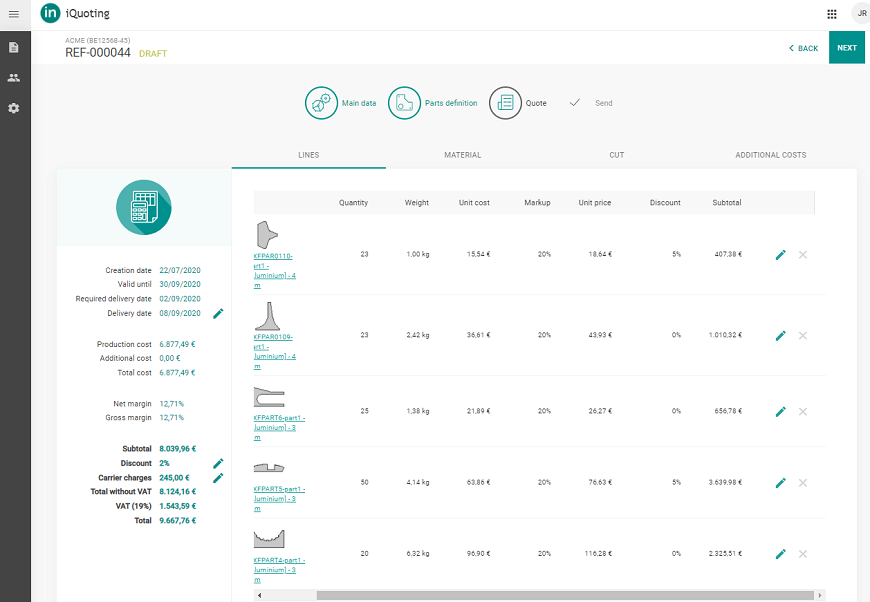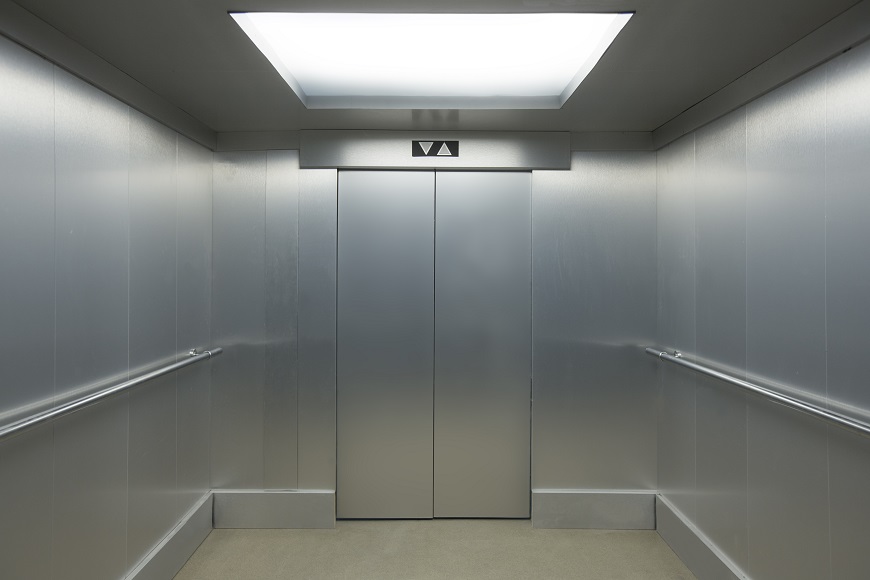
And it’s precisely the fact that we automatically assume it will be there that makes it essential for nothing to be lacking in the design and programming of elevators, escalators, mobile ramps or walkways. Infrastructures that need to be custom-made, making it necessary to use the latest software from the design phase to the after-sales phase, including manufacturing. Even more so when we’re tackling turnkey projects that require the orchestrated production of different departments (from DAO designs to the ERP and MRP) systems.
Lantek Expert is the ideal software for importing DAO data, it’s the most advanced CAD/CAM software on the market for sheet metal, especially designed to automate CNC programming while providing the most efficient nesting algorithms to maximize the use of materials in the cutting process of elevators, escalators, mobile ramps or walkways. All of this, thanks to the family that makes up part of this solution: Lantek Expert Cut (for oxycut, plasma, laser and water jet cutting machines),Lantek Expert Punch (punching machines), Lantek Expert Quatro (for shears) and Lantek Expert Duct (boiler works).
The Lantek software also allows you to group together a whole set of parts for one elevator, making it possible to manage complex products. This makes it much easier to search for and monitor a part that belongs to a specific job, order or client.
Subsequently, using this sophisticated program, manufacturers can use the parts according to their requirements at any time, always maximizing the use of material. It’s not without reason that the key principle in the metal and sheet metal industry is the optimization of the use of materials and time management in an aim to achieve efficiency in costs, productivity and, accordingly, maximum profitability.
And, specifically in the case of elevators, one of the most important elements in the world of elevation is being able to organize all of the different parts, which are very similar, as automatically as possible. For this, we have a system that allows parametric parts to be created and managed. Many of the parts are extremely similar, varying only in the total width or length. From one specific shape, and depending on several input variables, we can create a multitude of different parts.
Taking it one step further, with Lantek MESthe manufacturer can manage the factory in real time with the most sophisticated technology for the metal and sheet metal world. With Lantek MES Manager, the production processes can be managed and integrated with the aforementioned CAD/CAM solutions. This way, the manufacturer can find out the production status of each part in real time and optimize this with the delivery terms.
Within this family of manufacturing management programs there’s also Lantek MES Wos, envisaged to monitor and supervise production; Lantek MES Capture, for managing and monitoring operations in the workshop; and Lantek MES Inventory, to oversee all information regarding the inventory.
Consequentially, all of the processes can be monitored, from inputting data at the plant itself, monitoring tasks and machinery, to the after-sales phase, all safe in the knowledge that the status of the warehouse is under control, creating a production environment that is streamlined, efficient and integrated.
Success stories
We have several success stories, among them that of Grupo Orona, which has two production plants in Europe and is active in over one hundred countries with over 250,000 elevators. One in every 10 new elevators in Europe is made by this manufacturer, the first in the elevation sector to receive the ISO 14006 certificate from Ecodiseño. Orona offers maintenance programs for all elevator brands and models and, as well as remodeling and modernizing elevators and walkways, installs new equipment and updates elevators in old buildings, resolving any architectural issues.
Another client worth highlighting is Sematic Group, a supplier of components for elevators and automatic doors for manufacturers such as Schindler,Real Engineering or Robinson Engineering, these last two use Lantek software to offer speed and high quality to their clients. Equally, Sematic Group works on the modernization of these infrastructures. It has over a dozen affiliates located across Italy, the United Kingdom, Hungary, Germany, Turkey, India, China, Singapore, Mexico and the USA.
We also work with Schindler, a company we have already mentioned which is present across all five continents and has been active for over half a century in Spain. Our laser cutting model allows the manufacturer to improve the quality and production of their installations. At their plant in Zaragoza, the programming of different cutting machines has been unified using one solution in an aim to reduce the complexity of processes and optimize the machinery to gain in flexibility when alternating the workload between the cutting machines.
Other noteworthy clients are EMESA and MP Ascensores in Spain, Otis Elevator in China or ThyssenKrupp Elevator in Brazil.