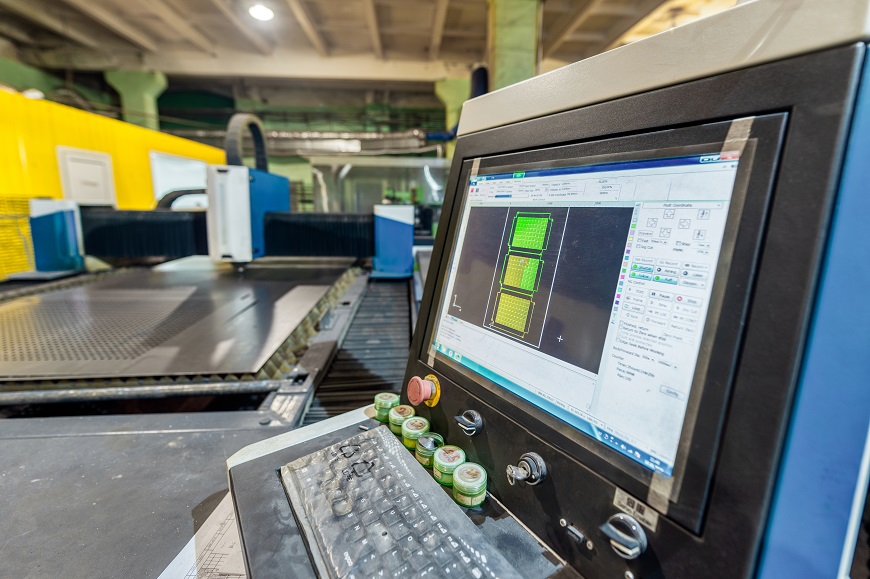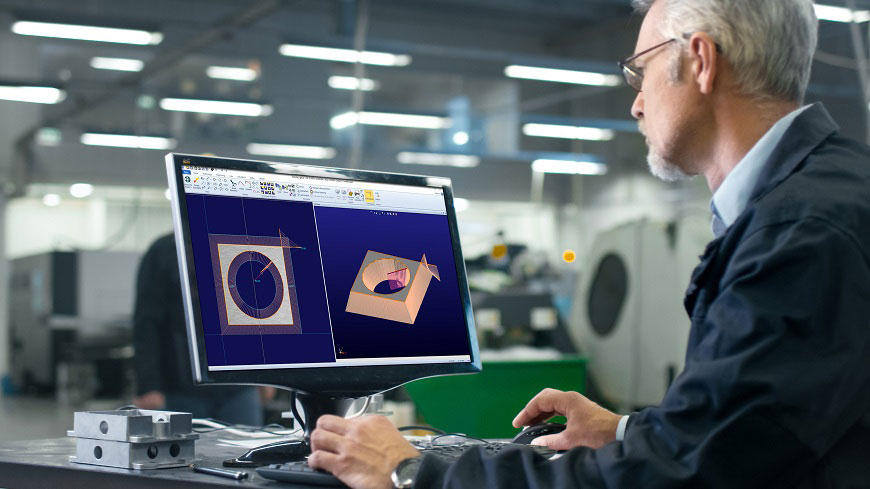
Nowadays, with programs, numerical control machine tools can perform complicated sheet metal cuts on complex surfaces with a high level of precision. In this type of machining, the piece to be cut is designed using CAD/CAM manufacturing software. Admittedly, given the complexity, inaccuracies can occur which, if not anticipated, may end up affecting the end result.
How can we save and/or minimize possible errors in machining? Effectively, the answer lies in the digitization of the machine tool, a process that has its costs, but where the benefits in terms of profitability and plant efficiency are greater and noticeable more quickly. Adopting 4.0 technology provides high quality standards, a capacity for large-scale manufacturing in less time and better performance and features.
Within digitization, machine tools can work in virtualized environments using advanced software, where the files generated by CAD/CAM are analyzed beforehand and compared with the file developed in 3D through the simulation of the machining from numerical control. This simulation allows us to see each step of the processing in a very detailed and precise way, indicating the critical points in the machining. This means that the operator can intervene by modifying any stage of the processing, even before production of the real part begins, increasing the performance of the machine tool and the quality of the final product.
Therefore, in a digital environment, errors that may be caused by anything from editing in the CAD system to the performance of the CAM system or the post-processor are reduced; from the parameterization of the CNC to the mechanical system of the machine itself.
We can take things a step further in optimizing and reducing errors in machining with the automation of processes achieved with the connectivity of machines. It’s what’s known as the Internet of Things (IoT), a technological enabler which all plants use to communicate with each other and which stores all of the data. Software with Artificial Intelligence and Machine Learning algorithms process all of this information, carrying out a predictive analysis of the performance of the entire production chain to offer solutions in an aim to optimize the plant. This way, steps are automated, detecting possible failures and providing quick responses to different scenarios (demand peaks, machine maintenance, workload redistribution, lack of stock, etc.).
With this convergence of technological enablers, we attain intelligent computational solutions and turn our factory into a Smart Factory.
Ultimately, the optimization of machining is possible through the connectivity, automation and virtualization of environments prior to actual manufacturing. However, it is important to emphasize that digitization does not replace, but rather complements, because if the tools and programs we work with do not offer the quality, appropriate standards and precision required, digitization will be of no use to us.
In the highly competitive environments that we face, and that require rapid adjustment and adaptation to new disruptive needs, cost control, increased productivity and efficiency are key for factories in the sheet metal and metal industry. As stated earlier, digitization is essential in order to attain optimization solutions that reduce costs, times and anticipate, correcting possible failures.
It doesn’t matter what size your factory is, small, medium and large ones all have to be on the same level in terms of digitization. The collaborative and co-creation solutions model is essential for this. At Lantek, we’re working hard to be the partner of choice to optimize sheet metal and metal plants with advanced software, and we’re doing it for one reason only: to help you and accompany you in digital transformation.