Companies in our industry are more conscious everyday about their need to digitally transform. However, they are facing the challenge of how it is to be adopted in their organization.
Article by Juan José Colás, Chief sales and Marketing Officer
The same questions are present: Is my company ready and sufficiently mature to make the necessary changes for digital transformation? What are the initial barriers and challenges we will face? Will we access quality data and will these data allow us to identify patterns that lead to better decision-making?
According to a report from Forbes Insights and consulting firm Ernst & Young, based on feedback from 1,500 executives from large corporations worldwide, 66% of companies with a well-defined analytics strategy improve their operation margins and profits by more than 15%.
Regardless of the degree of digitalization of a plant, it is imperative to have data on each of its processes to have a clear vision that enables better decision-making.
For the data to be useful, it will be necessary to count on a well-defined selection criterion and quality data. Data Analytics will then be critical to enable future-looking decision-making processes.
In this process, aided by specific software and other technology tools, management will be able to make the best decisions at all times in terms of production schedules, maintenance, processes, inventory management, and prevention of potential scenarios that could delay production and hence correct these issues.
There is no excuse for our industry, and every company in it, not to adopt the digital transformation and take a step forward.
Cutting and bending sheet metal accurately is a challenging task, especially when the job involves tight tolerances and complex geometries. It often takes time, skill, and multiple tries to meet customer specifications.
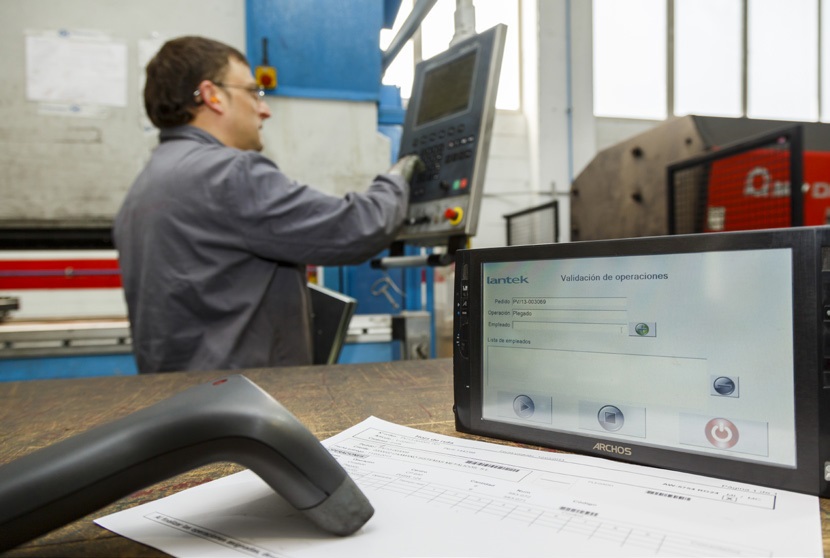
Shop floor control is a key component that substantially affects the decision-making process of any company. In this article, we will analyze the scope of efficient resource management and its related activities to help companies successfully transition from planning to reality.
Could you imagine a situation in which from anywhere of the world you were you could access in real time to your plant’s information? Wouldn’t it be perfect to control your company’s production from any device? Even if you are at your own plant, wouldn’t be a huge technological advantage to manage any process from anywhere? And yet more relevant, be able to collect the information coming from any cutting machine in the market?